The Dinar Collapses Versus 5 Hard Currencies In Official Exchange Market

-
-
742
-
0
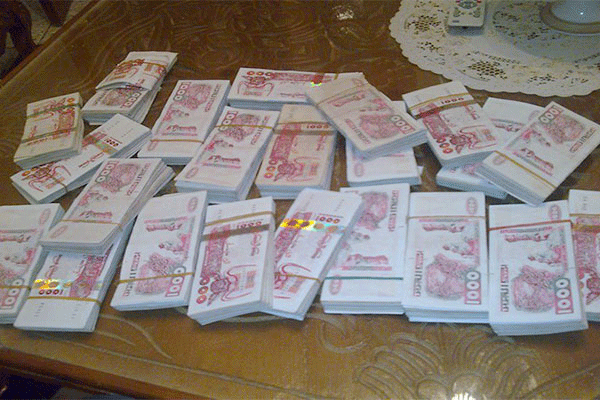
Despite the recent assurances of the Minister of Finance, Mr. Abderrahmane Raouya, who asserted that the Dinar’s exchange rate will remain stable against the Dollar and the rest of the hard currencies until the year 2020, and won’t witness a value decline, the national currency has nonetheless been gripped by a daily devaluation at the level of bank exchange desks, every passing morning for several days now.
On Tuesday, the Dinar currency again slumped as the value of the Euro against the Algerian dinar was set at 135.38 dinars in the official market.
According to the currency conversion indexes at the bank level, the dinar also fell against the Dollar, where the exchange rate was set at 115.10, after the recent rate was fixed at just worth 109 dinars, while the exchange rate of the Euro hiked to more than 135 dinars as last week’s Euro rate was equivalent to 133 dinars.
A few weeks ago, the latter did not exceed 121 dinars, while the Algerian currency collapsed even against the British Pound, which retreated against other hard currencies after the withdrawal of Britain from the European Union, and today the price of the British Pound is set at 151.81 dinars but 3 months ago, it was equivalent to just 139 dinars.
Likewise, the Algerian Dinar also plummeted against the Renminbi, or the Chinese Yuan.
This comes in the midst of a situation of acute instability of the Dinar in the face of hard currencies notably at the level of Algiers’ Port Said informal currency exchange market, and in other provinces of the country coinciding with the Bank of Algeria’s recent decision to print fresh money to provide investment-oriented liquidities to the Public Treasury.
A member of the Finance and Budget Commission of the National People’s Assembly Mr. Cherifi Ahmed told “Echorouk” to this effect that the MPs had received a formal pledge from Mr Raouya, the Finance Minister, during a recent meeting that the printed money will be directed solely towards fostering profit-yielding investments in various sectors of activity and not towards foodstuffs and beverages’ consumption.