The Élysée Palace Intervenes Regarding The French Ambassador’s Statement
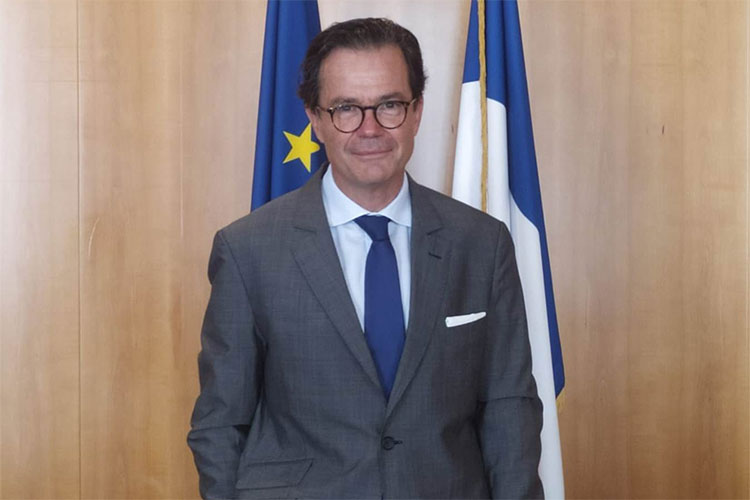
The statements made by the French Ambassador to Algeria, Stéphane Romatet, regarding increasing the number of visas granted to Algerians, continue to spark controversy within the gears of the French state, giving the impression that there is something amiss putting the truce that characterized bilateral relations in recent months on a razor’s edge.
Despite the confirmation by two ministers in the current French government, namely Benjamin Haddad, Minister Delegate to the Minister of Foreign Affairs, in charge of Europe, and the Minister of Overseas Territories, Naïma Moutchou, that what was included in the French Ambassador’s statements is not on the government’s agenda, the French President, Emmanuel Macron, decided in turn to delve into this issue despite its resolution, which indicates the existence of political goals behind it..
In a move that surprised observers in terms of its objective, Emmanuel Macron announced on Wednesday, July 22, at a cabinet meeting, that France has not set any “numerical goal” regarding visas granted to Algerians, according to Agence France-Presse (AFP), in a direct response to the Ambassador, Stéphane Romatet, who has been back in Algeria for only about two months now.
The Élysée Palace’s position on this issue, as reported by the French government spokesperson, Maud Bregeon, confirmed that the matter goes beyond the “visa” issue, becoming a message that Algerian-French relations may have entered a dark tunnel after indicators that appeared earlier that they were on their way out of the crisis, following the mutual ministerial visits between the two countries since the beginning of this year.
This approach is embodied by the French President’s use of a phrase that reeks of escalation, when he said that France shows “no laxity” in this regard (the visa), in an implicit condemnation of the statements of the French Ambassador to Algeria, which had sparked off sharp controversy, especially among right-wing and far-right politicians.
The French government spokesperson, Maud Bregeon, noted that Emmanuel wanted to correct the statements made by France’s ambassador to Algeria, which have spread widely in recent days, particularly regarding the number of visas. She added, quoting the head of state: “There is no specific goal for the number of visas, and there is no laxity on the part of France.”
The French Ambassador had given more than one interview on the occasion of the French National Day on July 14, but the interview that triggered off controversy was the one in which he said that he returned to Algeria with “great joy” and with a mandate entrusted to him by the French President, which is to return relations between the two countries “to their correct path.”
He also expressed his hope that the number of visas issued to Algerian citizens would return to pre-crisis levels, i.e., 250,000 visas annually.
In less than a week, four French institutions (the Minister Delegate to the Minister of Foreign Affairs in charge of Europe, and the Minister of Overseas Territories, before the matter reached the government and the presidency) came out to deny what was said by Stéphane Romatet. There is no doubt that the matter reaching the Élysée Palace and assigning the French government spokesperson to deny the Ambassador before French public opinion hides messages that the French party wanted to convey, so what are they?
In this context, the former official at the Ministry of Foreign Affairs, Mostafa Zeghlach, believes that the Élysée Palace’s entry into the line of the French Ambassador’s statements about visas granted to Algerians is a message that Paris is proceeding with a policy of stringency with Algeria, even if the visa is a sovereign issue for states.
Mr. Zeghlach explained, in communication with “Echorouk”, that the French President’s involvement in denying his ambassador means that Paris considers the “visa a means of pressure” on the Algerian side in order to achieve certain goals, noting that bilateral relations are hostage to pending files that the two parties have been pulling between them for about two years.
The retired diplomat doubted that the French Ambassador made those statements on his own, asking: “Does the Ambassador dare to make a statement of this kind without returning to his superiors?”, explaining: “Perhaps the Ambassador wanted to show some flexibility to facilitate his mission, as well as to reduce tension between the two countries.”
Regarding the intervention of more than one minister in this case, Mr. Mostafa Zeghlach did not rule out that the ministers delved into the subject based on their political affiliation, which is a practice that exists in democratic countries, and their political position hostile to Algeria may have played its role for electoral purposes, especially if this background was right-wing or far-right.