The Fall of the Makhzen’s Servant in the Arab Maghreb Union
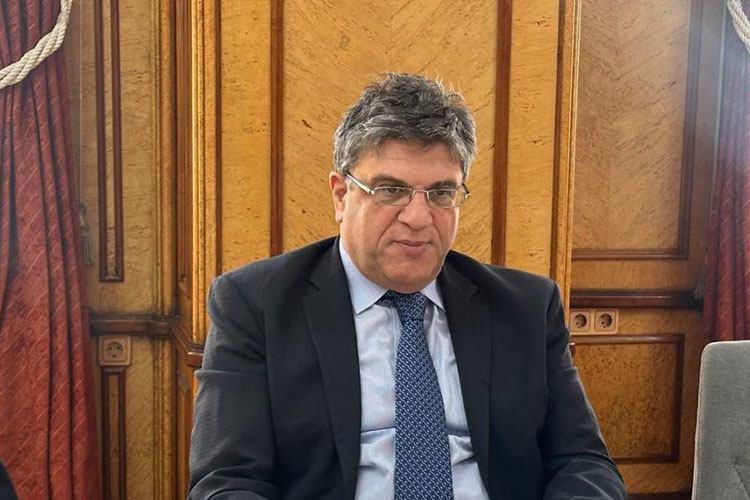
The Tunisian Ministry of Foreign Affairs announced the appointment of Tunisian diplomat Tarek Ben Salem as the new General Secretary of the Arab Maghreb Union for a period of three years, starting next June, to succeed his compatriot, former Tunisian Foreign Minister Taieb Baccouche, who was appointed to the position since May 2016, and who played a negative role in the Maghreb Union and became more like an employee in the Moroccan Foreign Ministry.
The Tunisian Foreign Ministry said that “the appointment of Tarek Ben Salem came “following the requirements of the Treaty establishing the Arab Maghreb Union in 1989, on the proposal of President Kais Saied, and after the approval of all the leaders of the member states of the union.”
Tarek Ben Salem, 64, is considered one of the Tunisian Ministry of Foreign Affairs executives. He worked for decades in diplomacy, after joining the ministry in 1990 and holding several positions, the most recent was Extraordinary and Plenipotentiary Ambassador of the Republic of Tunisia to the Russian Federation in 2019.
This Tunisian step coincided with the consensus of the members of the Maghreb Union, which experienced a “state of clinical death,” which prompted President Abdelmadjid Tebboune to search for broader mechanisms and spaces for consultation and coordination with neighbouring countries, which led to the holding of a tripartite meeting between President Tebboune and his Tunisian counterpart, Kais Saied, and the head of the Libyan Presidential Council, Mohamed Younes el-Menfi, in Tunisia.
The three leaders also agreed to “coordinate efforts to secure the common borders from the dangers and consequences of irregular migration and other phenomena of organized crime, and to develop (border) regions, and to unify positions in dialogue with the various countries concerned with the phenomenon of irregular migration between countries in the northern Mediterranean and sub-Saharan African countries.”
Leaders of Algeria, Tunisia and Libya called for establishing “major projects and investments in areas such as grain and fodder production and seawater desalination” to achieve water and food security for the three countries.
Algeria affirmed, through President Tebboune, that “the consultation initiative aims to discuss matters that concern us and our problems that are similar to each other, and are not directed against any of the Maghreb countries or any other country.”
Algeria’s Minister of Foreign Affairs, Ahmed Attaf, reinforced this proposal when he confirmed that “the new consultation framework is not a substitute for the Arab Maghreb Union and is not directed against any party, and the door to consultations remains open to everyone if there is political intention and will.”
The decision to remove Taieb Baccouche, who was described by Foreign Minister Ahmed Attaf as an “impersonator”, could bring about some breakthroughs in the work of the Maghreb Union, especially since he played a negative role during his tenure in office, and he was transformed from Secretary-General into an implementer of Morocco’s hostile policies against Algeria, as he was behind the appointment of a Moroccan diplomat that represented it in the African Union without consulting the member states, then directed false accusations against Algeria saying that it did not pay its financial share in the Maghreb Union.
Previously, the Algerian Foreign Ministry responded to Taieb Baccouche’s fool statements stressing that “Algeria is the only member that has never initiated a request to freeze the activities of Maghreb institutions, contrary to the slanders of the outgoing General Secretary of the Arab Maghreb Union.”
The Foreign Ministry explained that “the outgoing General Secretary of the Arab Maghreb Union continues his media missteps, trying in vain to mislead Maghreb public opinion and falsify the facts by placing responsibility for the faltering Maghreb success on Algeria, the only member of the Union that has previously ratified all the agreements concluded within the framework of the Maghreb Union since its establishment, with the unconditional support for the activities of all Maghreb institutions and their economic, social and cultural projects, and has never taken the initiative to request freezing the activities of Maghreb institutions”.
The Algerian Foreign Ministry asserted that “the former General Secretary reaffirms, through his condemned misleading media statements, that he does not live up to the level of responsibility and trust placed in his person,” noting that “with his slanderous statements and illegal actions, he takes positions that completely contradict the principles and objectives of the Maghreb Union, which he falsely claims that he is still head of its secretariat.”