These are the backgrounds of Algerian aid to Sahel countries
Developmental and social projects funded by Algeria continue in the poor Sahel region. After Niger and Burkina Faso, this time it was the turn of another neighbor close to Algeria’s southern borders, the Republic of Chad, whose President, Mahamat Idriss Déby Itno, visited Algeria on April 21st.
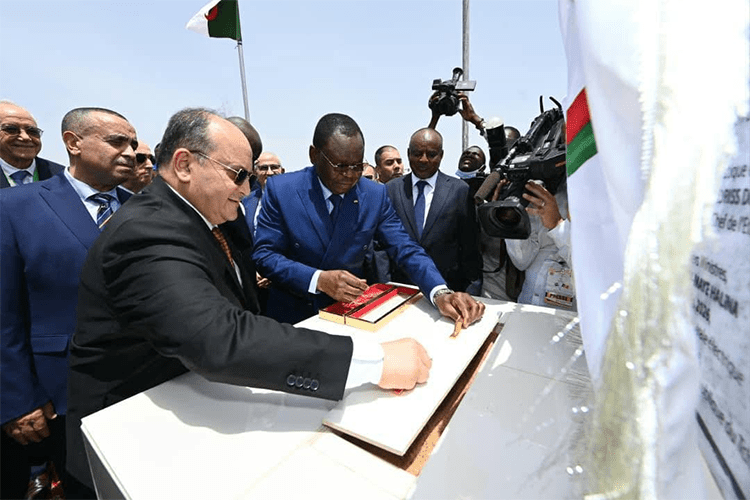
During the visit that led Prime Minister Sifi Ghreib to Chad, he, along with his Chadian counterpart, Lamai Halina, oversaw the laying of the cornerstone for a power plant project donated by Algeria. This is the second power plant built by Algeria in the Sahel region, after the one inaugurated by the same official in Niger less than a week ago, which was, as is known, constructed by Sonelgaz International.
The 40-megawatt power plant, which will be built in Chad by Sonelgaz, is a gift from the Algerian state to the Chadian people. This step came in accordance with the directives of President Abdelmadjid Tebboune, embodying the “firm political will” of the leaders of both countries, aimed at elevating Algerian-Chadian relations to the level of a “strong strategic partnership, based on effective solidarity, joint development, and mutual interests,” as stated by Prime Minister Sifi Ghreib.
Sonelgaz International’s activity is expected to expand in the African continent, with the establishment of power plants in several other African countries that have strong relations with Algeria, such as Côte d’Ivoire and Mozambique, as stated by the Minister of Energy and Renewable Energies, Mourad Adjal, during the inauguration of another station in the Nigerian capital, Niamey, last Wednesday.
Before that, Algeria had completed other related projects in Niger, such as the development of the “Kafra” oil field in northern Niger, near the country’s southern borders, in addition, of course, to the largest inter-African projects, the Algerian-Nigerian gas pipeline project, which officially began work on the fourth of this month, connecting Algeria to Nigeria via Niger, before reaching the European continent (Italy or Spain or both), providing developmental opportunities, especially in the Sahel region.
So, how can these initiatives be interpreted? Do their dimensions stop at the social and solidarity aspects, or do they extend beyond that to considerations related to geopolitical dimensions and calculations in an unstable region that appears theoretically poor but is, in fact, rich in latent resources, making it a target for the ambitions of global powers?
In response to these questions, Mr. Mohamed Khoja, former director of the Institute of Political Science and International Relations at Algiers 3 University, believes, in a conversation with “Echorouk,” that Algeria’s actions towards its southern neighbors fall within the geopolitical requirements imposed by contemporary political and security necessities.
Mr. Khoja said that “Algerian aid to neighboring countries and the African Sahel (such as Niger, Mali, and Chad) is a strategic tool, combining historical heritage and political necessities imposed by contemporary security,” and is part of the “doctrine of African solidarity that emerged with the beginnings of the formation of Algerian diplomacy during its liberation struggle; where the support of African peoples for the Algerian revolution (1954-1962) was the cornerstone for building strong relations after independence.”
On this basis, the speaker added, “Algeria adopted, since the mid-1950s and 1960s, the concept of South-South cooperation as an economic and political mechanism to break dependence on former colonial powers and achieve effective independence for states, especially in the economic and developmental fields,” especially since Algeria “views the Sahel countries and its regional neighborhood as a strategic depth affecting its national security in all its dimensions.”
Unlike France and the European Union, Algeria, according to Mr. Mohamed Khoja, advocates for a development approach as an alternative to military intervention. Algeria also believes that a purely security approach is not enough to eliminate terrorism and organized crime in the Sahel; rather, economic and social stability must be supported to dry up the sources of recruitment for extremist groups.
In light of the successive French withdrawals from Sahel countries and the escalating international competition (Russian, American, Chinese) in the region, Algeria, according to the speaker, seeks through humanitarian and developmental aid to maintain its role as a leading and neutral regional actor, based on this aid aimed at preventing the collapse of these countries, and thereby securing the borders connecting it with Mali and Chad, which have experienced successive political and security crises, by avoiding massive flows of displaced persons and illegal immigrants towards the Algerian borders.
In the opinion of the former director of the Institute of Political Science, President Abdelmadjid Tebboune has introduced a new mechanism to support Algerian foreign policy by directing and activating the Algerian Agency for International Cooperation as a key executive arm for cooperation relations between Algeria and African countries, to finance development projects in African countries, especially neighboring countries.
These aids, Mr. Khoja says, are directed towards joint infrastructure projects, such as investing in major regional projects to break the isolation of Sahel countries, like the African Unity Road, which connects Algeria with Niger, Chad, and Mali, in addition to developmental and strategic projects such as the pivotal fiber optic project, and the Trans-Saharan Gas Pipeline Nigeria – Niger – Algeria, as well as sending air and land convoys loaded with food, medical supplies, and tents, providing training and scholarships, and hosting thousands of students and military and civilian cadres.