Wage strikes increase pressure on Algerian government

الشروق أونلاين
-
-
1103
-
0
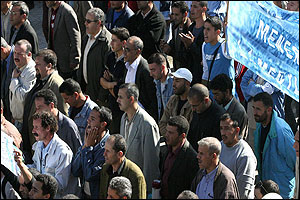
The Algerian government will meet with union and business leaders to negotiate a higher monthly minimum salary for public sector workers.
-
Six autonomous education unions took to the streets of Algiers during the annual return to business activities following the summer holiday. The strikes, staged on Monday (October 5th), protested the current minimum wage, decrying the rates as out of step with economic and political realities.
-
“Public sector workers find themselves right at the bottom of society, with the lowest purchasing power,” said M. Sadli from SATEF, the autonomous union of workers in education and training. “This is our way of showing how angry we are.”
-
The strikes come on the heel of an announcement made by the Algerian government in September, declaring that a tripartite meeting would be held to negotiate the monthly minimum wage. Pressures to revisit the issue have been gathering steam all year.
-
According to the government, the meeting – which will include the Algerian General Workers’ Union (UGTA), business leaders’ organisations and the prime minister – will decide on a possible rise to help workers cope with their crumbling purchasing power.
-
A specific date for the meeting has yet to be announced. The autonomous unions have not been invited to the negotiating table, and the strikes are partly in protest of this decision.
-
Since President Bouteflika entered office in 1999, the national guaranteed monthly minimum wage has been increased on three occasions, rising from 6,000 dinars to 12,000 in 2007.
-
However, any gains for workers have been wiped out by galloping inflation, which rose from 1.6% in 2005 to 3% in 2006, 3.5% in 2007, and 4.4% in 2008. Inflation rates look even worse for 2009, rising to 6.1% in the first quarter and 5.4% between July and August.
-
The UGTA and Labour Party have pushed for wages as high as 35,000 dinars per month, but the Business Leaders’ Forum (FCE) advocates a more moderate increase in light of the troubled economy.
-
The business leaders warn that raising the monthly wage will not solve the larger problems facing the industrial sector. Finance and excessive charges have hurt businesses, as well as the fall-out from the devaluation of the dinar.
-
“If our businesses continue to face all kinds of problems, they will not be able to cope with this rise” in monthly wages, said Reda Hamiani, president of the FCE.
-
Noting this, Hamiani said that a monthly wage increase to 20,000 “would be more in line with economic realities.” He added that because businesses had no other choice, the increased wages would have an effect on product prices, “and the result will be that they risk being forced out by the market by the competition. So there is a risk that the rise will not be implemented,” he said.
-
Boualem M’rrakech, part of the Confederation of Algerian Employers, is more concerned the future of businesses.
-
“We are saying that what we need today is a restoration of workers’ pay in relation to purchasing power.
-
However, we feel this increase must be linked to the business situation, because if there is an increase in charges here, it will be bound to have cost repercussions.”
-
Algerian economist Abdelhak Lamiri said it is important for salaries to be considered alongside the parameters of productivity, economic growth and inflation.
-
“The available statistics show that salaries in Algeria are lower than those in other countries with a similar level of development. But they are higher than Algerian productivity, so they are being subsidised by the income from oil. This is the dilemma facing countries whose economy relies on such income,” he said.
-
The economist said the only way of settling the problem satisfactorily would be to improve productivity in wealth creation, meaning that every Algerian would have to produce more and better-quality products at all levels of the economic sphere.