Algeria And Spain Officially Turn The Page On The Crisis Following Sanchez’s Visit To Algeria
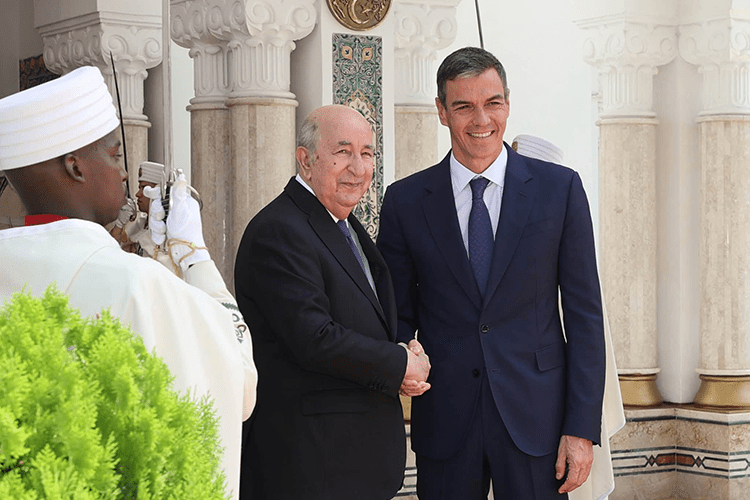
Algerian-Spanish relations are heading towards further strengthening after the visit led by the President of the Madrid Government, Pedro Sanchez, on Monday to Algeria, thereby formalizing the end of a short-lived crisis between the two countries.
These developments occurred in a context characterized by Algeria bolstering its relations with major European countries such as Germany, alongside a noticeable deterioration in the relationship with France.
Less than a decade ago, relations between Algeria and Paris were ahead of other European capitals, and at that time, French interests were prioritized over those of other European Union member states. However, the acceleration of events since 2019 shuffled the deck in a scene where the data was turned upside down due to what the Algerian side considers repeated French provocations that counter Algeria’s geopolitical interests.
This factor contributed to reaching the current situation, marked by the Algerian authorities’ decision to restructure their foreign policy to accommodate their vital interests. Hence came the vitality characterizing Algeria’s relations with its European neighbors, and the visit of the Spanish Prime Minister is but one stage of this new orientation.
In the view of the diplomat and former official at the Ministry of Foreign Affairs, Mustapha Zeghlache, Pedro Sanchez’s visit to Algeria is considered a culmination of the two countries’ success in overcoming a crisis that proved over time to be fleeting. The Sahrawi issue was at the heart of that crisis, which has become a thing of the past with President Abdelmadjid Tebboune’s announcement of preparations to hold the 8th session of the Algerian-Spanish High-Level Meeting next October.
The Spanish government’s decision to support the autonomy plan in Western Sahara triggered the dispute between the two countries in 2022. However, the Spanish side, which was under great pressure from the Moroccan regime (referring to opening access points for illegal migrants), according to Mustapha Zeghlache, knew how to get out of that predicament after it later decided to bind the Spanish decision to what international laws and norms dictate, unlike other neighboring countries that still view the autonomy plan submitted by the Moroccan regime in 2007 as the one and only solution, bypassing the relevant United Nations resolution.
Mr. Mustapha Zeghlache told “Echorouk” that “some are trying to cast doubt on the Spanish position regarding the Sahrawi issue and are trying to target relations with it, but Madrid’s position on this issue has become clear and stable for some time.
It has confirmed on more than one occasion that it stands with international legitimacy and relevant UN resolutions, and that it does not view autonomy as the only solution, which is a balanced position that cannot be disparaged.”
The retired diplomat believes that the Spanish side’s position involves a great deal of moderation and rationality, which contributed to lowering tensions. This led to limiting the repercussions of the diplomatic rupture on commercial and economic relations, from which both sides suffered but to varying degrees.
He noted that Spain will gain much, just as Italy and Germany did before it, from this rapprochement, because the potential Algeria possesses and the privileges it offers to its reliable European partners (the three countries), especially after the Russian war on Ukraine, cannot be provided by any other country in North Africa, and herein lies Algeria’s uniqueness.
The biggest loser in the equation of Algerian rapprochement with major EU countries remains France, which placed all its eggs in the Moroccan regime’s basket.
Mr. Mustapha Zeghlache noted the significant decline of French interests in Algeria with the emergence of new competitors such as China, Germany, Italy, Turkey, and Spain. This is likely to make Paris lose some of the privileges its companies enjoyed in Algeria compared to companies from other European countries, while conceding that not much remains of the relations between Algeria and Paris except for the human aspect, referring to social ties (the Algerian community), which are considered remnants of the colonial era.
Due to French positions with uncalculated consequences, Mustapha Zeghlache did not rule out that Paris would suffer the loss of its remaining interests in Algeria, which are no longer beyond the energy sector, which Italy, Spain, and Germany seem to have monopolized, taking advantage of the specific circumstances.
This is a reality the French side bears, as it did not play the de-escalation card well, which is no longer on the agenda for the time being, with the return of French provocations starting from the statements of the French Prime minister, Sebastien Lecornu, from Rabat last week regarding the Sahrawi issue.