Algeria-USA: “Volatile Sahel Situation, Counter-Terrorism Struggle on John Kerry’s Agenda”

-
-
2746
-
0
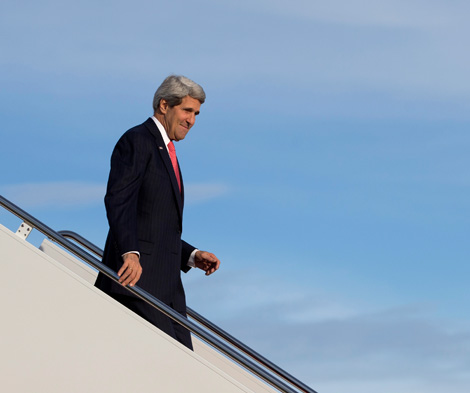
The US secretary of state, John Kerry started Wednesday a 2 day official visit to Algeria, at the invitation of foreign minister Ramtane Lamamra.
The foreign affairs’ ministry spokesman, Abdellaziz Cherif Benali, affirmed Wednesday that John Kerry’s visit to Algeria was an opportunity for the two delegations to discuss topical regional and international issues with on focus the volatile situation now gripping the Sahel region, counter-terrorism and the Western Sahara issue.
The visit reflects the keen interest shown by big powers towards Algeria, particularly during this presidential election period.
Mr Abdellaziz Chérif Benali said that Mr Kerry’s visit to Algeria at this particular pre-election period was a political message sent by Washington to those who had been endeavoring to scuttle or put off such a high-level visit.
This is evidence, he said, of the excellent relations existing between Algeria and the United States.
During his stay, John Kerry will be received on April 3rd by the head of state, Abdellaziz Bouteflika, with whom he’ll discuss such issues as the instability and tension in neighboring countries facing terrorism, a plague relentlessly fought by Algerian authorities thanks to Bouteflika’s wise policy and the determination and the efficient role of the National Popular Army.
The two sides will also tackle the Sahrawi issue, notably the extension of the Minurso mandate to human rights’ monitoring in the Saharawi territories due to the Moroccan forces’ unabated repression and exactions unleashed against the Sahrawi people.
The visit is part of the consultations and regular exchanges between the two countries aimed at enabling the two sides to hold the second session of the strategic Algeria-US-dialogue, under the co-chairmanship of Ramtane Lamamra and his US counterpart John Kerry, the foreign ministry’s spokesman underscored.
2013 has been the year of the security concerns, whether in the Sahel or in the countries of the sub-region; it was also the year during which Algeria proved its capacities to face up efficiently to terrorist groups of several nationalities.
A case in point was the heinous terrorist attack on the Tiguentourine gas facility in the southern In Amenas region which reflected the high degree of professionalism achieved by the forces of the national popular army (ANP).
The entire world then firmly denounced such an aggression and hailed by the same token the efficient way with which Algeria managed this crisis.
As a matter of fact, the big western countries including the United States extolled the efficiency of this security feat stressing that the terrorism scourge in the Sahel concerned all and sundry.
They followed Algeria’s steadfast stand describing terrorism as an intricate international phenomenon, thus requiring a more coordinated international mobilization in order to stamp it out.
The US government has to this effect stressed the paramount importance of such an international coordination and concertation by taking a leaf out of Algeria’s example.
Algeria’s efforts to foster a common security action at the regional and international levels were clearly highlighted through an intense flurry of diplomatic activities within a bilateral and multilateral framework notably in view of the developments witnessed by the Sahel and the Maghreb region particularly at the level of borders.
The reinforcement of regional efforts and the collective action against the common security threats required the holding of important meetings like the 15th conference of interior ministers of the western Mediterranean in Algiers as well as the meeting of the working group for the consolidation of the Sahel’s capacities, co-chaired by Algeria and Canada as part of the global counter-terrorism forum.
Algeria also marked its salient presence at the Paris summit for peace and security in Africa and pleaded for African solutions and joint action-plans.
Furthermore, Algeria hosted a high-level conference devoted to the bolstering of the concerted fight against the plagues of terrorism and organized crime.
Algeria also opted, together with partners from outside the region, for close security cooperation at the highest level, through strategic security cooperation commissions including representatives from Algeria, the United States, France, Great Britain and Germany.
These resolute actions reflect Algeria’s widely-recognized outstanding role in the region, coupled with the unflagging efforts made in the counter-terrorism struggle.