French Education Minister Refuses Apology To Algeria From His Country

-
-
282
-
0
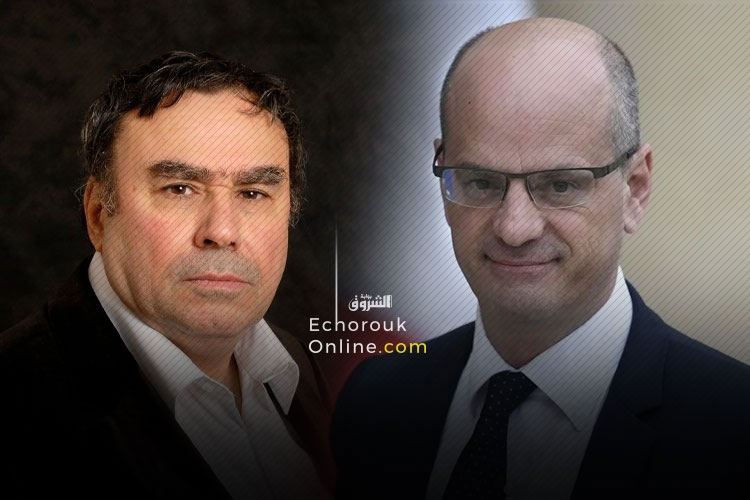
At a time when work is being done quietly and out of sight on the issue of dealing with the accumulations of the somber colonial past between Algeria and France, the French Minister of Education, Jean-Michel Blanqui, resurrected a discussion that caused a flare-up of tension in bilateral relations on more than one occasion.
The French Minister of Education, in an interview with the French channel “BFM TV”, expressed his firm rejection of Paris’ apology to the Algerian side for the hideous crimes of the French occupation, which the enemy witnessed before the friend, and the French themselves.
This statement comes from a French official at the level of a minister, at a time when the presidents of the two countries, Abdelmadjid Tebboune and Emmanuel Macron respectively, launched a path of calmness in the memory file, as one of the reasons that contributed to poisoning bilateral relations, by assigning each of Abdelmadjid Chikhi on the Algerian side and Benjamin Stora, on the French side, to work out a report, to be delivered before the end of the current year, aiming to finally close this burning memory file.
Michel Blanquer, who holds an official capacity in the government of Jean Castax, who was chosen by Emmanuel Macron, estimated that the “repentance” of one party without the other violates the principle of justice, which must be applied to “all memories”, as put it.
The French official intends to extend justice to “all memories”, an attempt to do justice to the “black Feet, as he put it, in a logic that can only be described as biased and misleading at the same time, as it puts the victim and the executioner on the same side.
French politicians insist on employing the word “repentance”, when it comes to memory with Algeria, and they are certain that repentance has a religious dimension, while the Algerians have never demanded France’s repentance, but an “excuse” for the occupation’s odious crimes, which is a demand completely far from religious considerations, whose aim is to fuel the popular French rejection of this well-known demand in international political and historical literature, which France itself had raised in the face of Germany after the Second World War.
Does Michel Blanquer mean that France’s official apology to Algeria affects the harmony and integration of French society?
The French official’s reopening of a disturbing speech in the file of Algerian-French relations means that there is resistance to President Macron’s tendency to calm Algerian-French relations in some official circles in the levers of the French state, an approach recorded by observers so as to lift the obstacles facing the historical reconciliation between Algeria and Paris.
Benjamin Stora, entrusted with the memory file by the Elysée Palace, expressed his shock at the lack of response of French politicians to the task he is undertaking, and spoke about the obstacles he faced in performing this task, especially with regard to dealing with some sensitivities in French society, such as the resentful “Black Feet” which are the sensitivities that often sparked off crises between the two countries.
As a reminder, the Minister of Mujahideen and Rightsholders, Tayeb Zitouni, recently indicated to this effect that the experts who have been working for two years on the census of crimes committed by the French colonisation against Algerians from 1830 to 1962 “have not yet completed their work because of the immeasurable number of these crimes”.
In response to the questions and concerns of deputies of the National People’s Assembly (APN) regarding the bill establishing the date of 08 May 1945 as the National Day of Memory, the minister stated that “historians were commissioned two years ago to carry out a census of all crimes committed by colonial France against Algerians between 1830 and 1962,” adding that they “have not yet been able to complete their work due to their immeasurable number”.
Considering it imperative for France to acknowledge its horrendous crimes and restore our archives, Mr. Zitouni said that his department is working on the production of documentaries on all the wilayas or provinces from the beginning of colonization in Algeria until independence. “Fourteen documentaries have been finalized,” he noted.
He also recalled that his department had submitted to the Ministry of National Education two years ago, prototypes for the teaching of history in the three levels and that contacts are underway with the Minister of Education for the signing of a convention on the methodology of teaching this subject.
On the question of the skulls of the leaders of the popular resistance, the minister reiterated that “Algeria, people and government, remains committed to this request and will never give it up”.
Stressing that Algeria “has nothing against the French people, among whom it counts friends who participated in its war of liberation,” the Mujahideen minister maintained that “trade, industrial and cultural relations between the two countries cannot weigh in front of the national memory.
He mentioned, in this regard, the issue of those who disappeared during the national revolution, whose number exceeds 2,200 Algerians, in addition to the issue of French nuclear tests in the Algerian Sahara, which “have made and continue to make victims.
Regarding the law criminalising French colonization, the minister stressed that this law “is not only a parliamentary demand but also a popular one”, proposing the association of historians in the drafting of this law “in order to revive other issues”.
Rejecting the idea of a “formal” law criminalizing the brutal French occupation, Mr Zitouni said “we do not need a law to be published only in the Official Journal but we want a law that will enable us to relaunch other issues”.