Rector of the Grand Mosque of Paris Attacks a French Study on Islam and Muslims
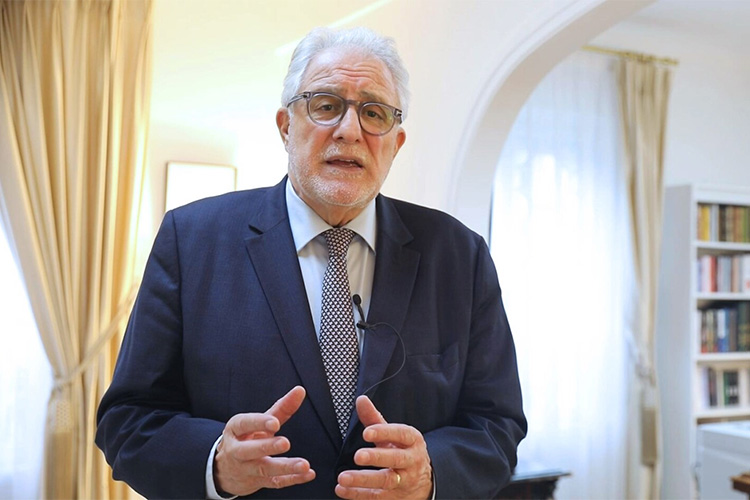
The rector of the Grand Mosque of Paris, Chems-Eddine Hafiz, criticised a study conducted by the French Institute of Public Opinion (IFOP) on Islam and Muslims in France, warning of its dangers to social harmony in France.
He emphasised that more than 90% of French Muslims respect the laws of the Republic, contrary to the study’s attempts to portray inaccuracies.
In a video posted on the Grand Mosque of Paris’s X account and an article published on the mosque’s website, on Wednesday, Hafiz said: “Some surveys shed light on the situation. Others shine too harsh a light, as if to create a pervasive sense of unease instead of informed understanding. The latest Ifop study for Écran de Veille (Screenwatch) unfortunately falls into this second category. Not because the figures lack rigour, but because the way they are presented leads to a distorted view of the situation.
“Yes, some young Muslims are more devout than before. They pray, they fast, they seek a deeper meaning than mere consumerism. There is a search at play, perhaps an anxiety, certainly a need for ideals and guidance. However, attributing a political agenda to this quest is a misinterpretation, because one would first need to understand the grammar of the faith in question,” he added, commenting on a recent Ifop study that presented figures which sparked considerable controversy within the Muslim community in France.
Hafiz focused on some of the questions posed to the survey respondents, explaining: “In Islam, prayer means performing the five daily obligatory rituals: the salat. An inner thought, a word whispered towards the heavens, du’a (supplication), does not have this status. Yet, the question posed in the survey is: “Do you pray at least once a day? Yes / No. And so the slightest spiritual stirring becomes a sign of strict orthodoxy. A naive statistic is transformed, through a rhetorical shift, into a discourse of danger”.
The rector of the Grand Mosque of Paris criticised the way the survey was conducted, which he said “from this confusion arises a convenient conclusion: spirituality, therefore rigorism, therefore ‘Islamist temptation,’ therefore radicalisation. Everyone finds what they already feared. The intellectual circle closes before it has even opened. Religion has been taken for proof of a project, the heart made into an ideology, and the believer transformed into a supposed adversary. The error here is not in calculation: it is in perspective”.
He pointed out that “yet these same figures reveal a reality that has been largely overlooked: an overwhelming majority of Muslims remain committed to the Republic and opposed to all forms of religious violence. They want neither theocracy nor separatism; they simply want the right to practice their faith without becoming suspects. It would still be necessary for the words used to have the same meaning for the person asking the question and for the person answering”.
Hafiz questioned the figures being circulated: “In the Screen Watch survey, the question was framed as the application in France of Sharia that would supersede French laws. The result: 46% answered ‘yes,’ of which only 31% answered partially. Immediately, some conclude: One in two Muslims wants to impose Sharia in France. However, in the other Ifop survey, commissioned last September by the Grand Mosque of Paris, respondents were asked what Muslims actually mean by Sharia. The responses are unambiguous: 29%: a personal ethic (eating halal, praying, sharing), 25%: a vague religious concept, without political translation, and only 25%: a legal system.”
Chems-Eddine Hafiz explained that, “Three out of four Muslims don’t see any political agenda behind this word.” This presents a striking paradox. The pollster asks, “Do you want to replace the Civil Code?” The respondent replies, “Do you want to maintain your personal morality?” Two completely different logics… which are lumped together under the same alarmist conclusion. And if a minority, around 3%, expresses a fascination with the most extreme forces and demands unwavering vigilance, this shouldn’t lead us to view 97% of loyal citizens as a group to be monitored. Because by asking the wrong questions, we always end up creating the very fears we claim to be measuring.”
The rector noted what he considered a “striking paradox”; “The other Ifop survey, commissioned by the Grand Mosque of Paris, reveals this: one in three Muslims has already experienced discrimination because of their religion. This figure rarely circulates in alarmist columns. And yet, it explains everything. Radicalisation is often merely the belated reaction to a long-standing humiliation. It is not prayer itself that creates division: it is the way it is perceived. What is missing from the Écran de Veille’s grid is not vigilance against minority excesses, but knowledge of religious facts. When a Christian says, “God created the world,” he is a believer. A Muslim says the same thing, and he becomes suspected of obscurantism. The same belief, two worlds. Not because of them, but because of us”.
“A society that scrutinises a community solely to uncover the worst aspects never discovers anything but its own anxiety. And theological ignorance then becomes a statistical weapon. If we fail to distinguish between prayer and supplication, between believer and activist, between private morality and political project, then Islam becomes a screen onto which fear projects its favourite film. The aim is not to deny what is alarming, but to understand what is transforming. Muslims are neither spectres that “return,” nor crowds that “switch sides.” They are women and men who live their faith in a country where they are a minority and, consequently, a faith that is far less known,” he added, “Let us hold ourselves to the same high standards of lucidity as we hold them to, because there is no Republic strong enough to allow itself to manufacture its own fears”.
In an interview on the news channel “BFM TV,” Hafiz expressed his regret that some French people focus on certain matters specific to Muslims, even though they do not harm the French in any way, such as the “foulard” (headscarf), which he said is not necessarily an Islamic symbol, and halal food. He also expressed his rejection of reducing Islam to “whether a man greets a woman or not?”