When the World Enters the Age of “Post-Masks”
There are moments in history when the world does not formally announce that it has changed—yet everything around you whispers that nothing remains as it was.
Moments without communiqués, summits, or declarations—yet maps shift, powers tremble, and moral standards collapse in a silence that resembles the deep rumble of an earthquake heard only by those who place their ear on the heart of the earth.
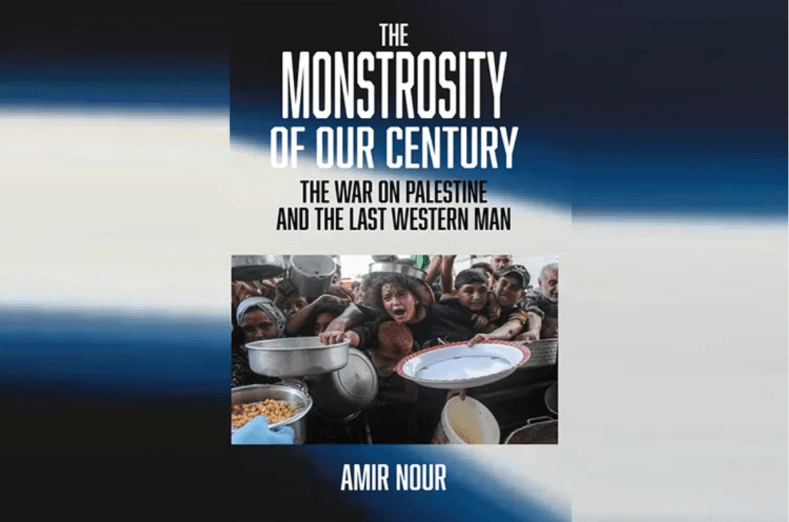
Chapter Eight of The Monstrosity of Our Century stands precisely at this moment. It does not embellish, dramatize, or theorize. It simply dissects, with surgical clarity, a world entering a phase of global transformation: a Western decline that can no longer be masked, and the rise of an international order unlike anything the modern age has known.
This third article does not summarize the chapter. It excavates beneath it—searching for what is said openly and for what can only be heard as a whisper in the margins.
1. The West Losing Its Ability to Hide Its Own Weakness
The chapter opens with a revelation that is subtle yet seismic: The West does not collapse like a statue falling in a public square. It melts—slowly—as ice melts under the unfiltered light of truth.
For decades, the West successfully concealed its contradictions: between values and interests, between principles and behavior, between rhetoric and reality.
But this moment—captured in the book with calm precision—reveals a new truth: The West can no longer hide anything. It can no longer justify, convince, or moralize. It now survives on the remains of an image it burned itself.
This is not an attack on the West. It is a sober diagnosis: Power that can no longer hide its weakness has entered the first stage of real decline.
2. The Silent End of the American Era
Chapter Eight does not describe a military defeat nor an economic failure. It describes something more devastating: the collapse of moral authority.
What the United States truly lost is not dominance, but the ability to define the world—to decide what is truth and what is propaganda, who is good and who is evil, whose life is worth mourning and whose death is a statistical footnote.
America no longer governs the world. It governs what remains of the belief that it still leads. Politically, that is more dangerous than defeat on the battlefield.
3. Europe: A Continent That Returned to Someone Else’s Shadow
Europe—once the continent of ideas, enlightenment, and moral leadership—is now described in the chapter as a waiting hall: A place where footsteps echo, but no exit sign is visible.
It takes positions it does not believe in, remains silent out of fear of standing alone, and repeats moral slogans it no longer has the will—or the power—to defend.
Europe today is not a power, but the residue of a power.
4. The International System: A Vacuum Quickly Filling
When one center of power weakens, the vacuum does not remain empty for long.
Chapter Eight traces the emergence of a new geopolitical landscape:
– China rising without noise
– Russia reasserting itself despite attempts at isolation
– India shifting toward strategic independence
– Turkey and Iran returning as regional power brokers
– The Global South moving from spectator to actor
This is not classic multipolarity. It is a managed transitional chaos, where the idea of a world run from a single Western room ends. The West used to be that room. It no longer is.
5. Why the World Is Returning to the Pre-Westphalian Moment
The chapter introduces a striking thesis: The world is returning to the pre-1648 era—before the Western-made definitions of statehood, sovereignty, borders, and international law.
Why? Because power no longer requires legitimacy to act. Because international law has lost its function. Because global institutions have become tools of the powerful. Because the West can no longer impose its concepts on others.
The Western cycle has ended. A new cycle has begun—its shape still blurry, yet its tremors felt across the planet.
6. The Greatest Fear: The Redefinition of the Human Being
The chapter’s most dangerous idea is not geopolitical. It is existential:
The world is not only witnessing a shift in power. It is witnessing a shift in the nature of the human being.
The human—once the center of morality, law, and justice—has become a subject, a variable in negotiations, a manageable detail within the architecture of global power.
The human has become:
– an index in humanitarian reports
– an incident in military briefings
– a statistic in media cycles
– a disposable unit in the calculus of nations
This is the core of modern monstrosity.
7. Why the Arab and Muslim Reader Must Understand This Shift
Because this transformation is happening to him, not around him.
When the West declines, it does not decline alone. When power centers multiply, rules change. When morality loses its place, the weak become weaker, the silent more exposed, and the hesitant more easily devoured.
Either the Arab and Muslim world understands this moment now, or it will again be forced to discuss the world in a language that is not its own.
8. What This Chapter Prepares Us For
This chapter is not a conclusion. It is a doorway into:
– the fall of Western moral centrality
– the exposure of global engineering
– the shift from moral to interest-based discourse
– humanity entering an age without a clear center
What will happen to the human being inside this emerging system?
The next article answers this:
Not the fall of the West nor the rise of the East, but the fall of the human between them—and the architecture reshaping consciousness to fit the coming world.
Because monstrosity is no longer an act—
it is a system.