Annan Leans on Iran As Cease-Fire Deadline Looms In Syria

-
-
948
-
0
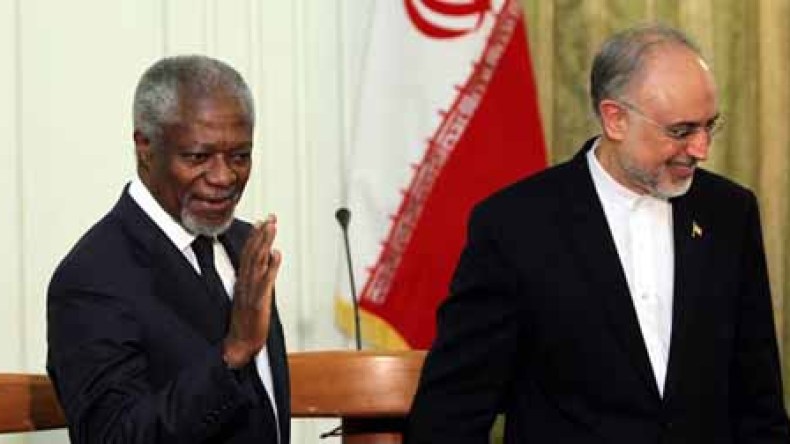
With a cease-fire deadline looming and no end to bloodshed, special envoy Kofi Annan leaned Wednesday on a key Syrian ally, Iran, to shore up support for his faltering peace plan.Annan, who brokered a timetable for peace in Syria, said in Tehran that he had received assurances from Damascus that guns would fall silent by the agreed Thursday deadline.Still optimistic that Syrian President Bashar al-Assad will comply with the early morning cease-fire agreement, Annan said “we should see much improved situation on the ground.”But images and reports from activists across Syria painted a grimmer picture and suggested that al-Assad remained intent on crushing the opposition with firepower.Homs resident Saif al-Arab described military planes over the besieged city. The London-based Syrian Observatory for Human Rights reported heavy shelling in two Homs neighborhoods.Soldiers were also out in force in the southern town of Maaraba, activists said.Shells rained on villages in Hama province and government soldiers were destroying homes, according to the Local Coordination Committees, a network of opposition activists across Syria. Renewed shelling was also reported in Idlib.In Raqqa, government forces, backed by heavy machine guns, raided a village, the LCC said.The death toll rose as the day wore on, as it does every day. At least 22 people were killed Wednesday, the LCC said.”The Annan plan will not succeed because I do not think Assad’s forces will carry out the cease-fire,” al-Arab told CNN, echoing similar sentiments from other Syrians angry over what they perceive as the regime’s empty promises in the peace process.”Assad will not withdraw his army and his military from Homs,” al-Arab said. “He is attempting to suppress the revolution by lying and dodging any demands (by the international community).”Annan, the United Nations- Arab League envoy, himself expressed grave concerns about the situation in Syria to the United Nations Security Council after al-Assad defied a Tuesday deadline for government soldiers to withdraw from population centers.Instead, Syrian forces pounded cities like Homs and Idlib and suburban areas of Aleppo and Damascus. The Syrian government said it took steps to pull back its forces, but Annan countered that while troops had moved out of some areas, they had relocated into others that were previously not targeted.Opposition activists have called on the international community to arm the rebels, clearly outmatched in strength by government forces.”The solution is to arm the Free Syrian Army with high quality weapons,” al-Arab said of the rebel fighting force, made up mainly of defected military members. “They are still using Kalashnikov and light rocket-propelled grenades against the regime’s military tanks.”Annan, however, warned against militarization, insisting that the issue has to be resolved through diplomatic channels.”Any militarization of the Syrian issue will be disastrous,” Annan said at a joint press conference with Iran’s Foreign Minister Ali Akbar Salehi.Annan’s peace plan calls for the government and the opposition to lay down their weapons by 6 a.m. Thursday local time (11 p.m. ET Wednesday).It is vital that regional leaders, including Iran, work with Syria to resolve the crisis, Annan said.”What’s important is that the governments in the region and beyond work together with the Syrians to resolve this current crisis,” he said. “This is a region that has seen many tensions and many shocks, and I don’t think it can afford another shock.”Iran, one of Syria’s strongest allies, opposes foreign intervention in the crisis.Salehi said Iran supported Annan as long as his mission did not endorse the idea of regime change in Damascus, Iran’s state-run Press TV reported.He said he hoped Annan would be successful in managing the Syrian issue “fairly.” Change in Syria, Salehi said, should be made by the country’s government.Iran used force to suppress its own opposition movement after the 2009 presidential elections. Syria’s anti-government protests erupted in March 2011, followed by a bloody government crackdown.