Neither the U.S. nor the Security Council: Only the Sahrawi people can decide the future of Western Sahara
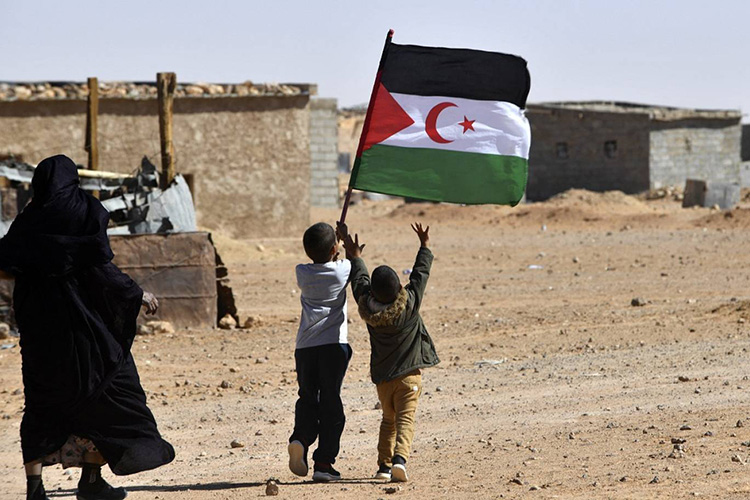
The international political scene is dominated lately by disturbing reports about the so-called American “zero draft” on Western Sahara, which certain circles within the US administration and the global Zionist lobby are seeking to impose on the United Nations Security Council as a draft resolution, exploiting Washington’s role as the Council’s penholder on Western Sahara.
From its first word to the last, this draft represents a dangerous departure from the principles of international legality and a flagrant repudiation of the Security Council’s own previous resolutions. More seriously, it poses a direct threat to regional and international peace and security. It rests on a unilateral, authoritarian logic that seeks to legitimise violations of international law and trample on the inalienable right of all peoples to self-determination, sovereignty over their homelands, natural resources, and future.
The Zero draft even crosses the boundaries of diplomatic propriety by attempting to glorify an alleged contribution of the current US administration to resolving the conflict. In doing so, it ignores a fundamental truth: imposing Morocco’s colonial fait accompli as the “only solution” or even as the “most feasible solution” sends a disastrous message to the international community that “might makes right,” rather than justice, law, humanitarian principles, or even the logic of mutual interest in building a world founded on mutual respect, cooperation and constructive partnership.
What the drafters fail to understand, however, is that the Sahrawi people firmly believe in their rights and remain unwavering in their determination to defend them. They will accept no tutelage, whether from the United States or any other power. They remain committed to resistance by all available means and prepared to pay the necessary price to defeat colonialism. Neither the United States nor any other power on Earth has the right, or the capacity, to impose a colonial outcome or dictate a coercive reality upon the Sahrawi people. Such attempts will collide with the immovable foundations of history, legitimacy and reason, and, above all, with the capacity of peoples to achieve miracles and overturn the calculations of colonial powers, whose plans history has repeatedly consigned to failure.
Washington and other powers may choose to support the Moroccan occupation politically, economically or diplomatically. What they cannot do is break the Sahrawi people’s will or force them into submission. Any attempt to impose a colonial fait accompli will leave the Sahrawi people with every legitimate means of resistance available under the United Nations Charter and the rules of international law, until the occupation is defeated and full independence achieved.
It must also be made clear that the Sahrawi people’s sovereignty over their homeland is absolute and cannot be negotiated away or relinquished. Neither the United States, nor the Security Council, nor any international body has the authority to determine the future of Western Sahara or tamper with its legal status as an occupied territory subject to a United Nations decolonisation process.
Only the Sahrawi people, represented exclusively and legitimately by the Frente POLISARIO, possess this sovereign right. Our destiny has never been a gift bestowed by anyone, and we will never surrender it to anyone. The Sahrawi people made their choice in 1973, when they fired the first shot of their revolution against colonialism. They reaffirmed that choice in 1976 with the proclamation of their free and independent state, the Sahrawi Arab Democratic Republic (SADR). They subsequently consolidated their statehood and reaffirmed their commitment to it through the SADR’s admission as a full member of the Organisation of African Unity in 1982 and its status as a founding member of the African Union in 2000.
The message of the Sahrawi people to the international community, to its states, organisations and peoples without exception, is therefore clear and unequivocal: the Sahrawi Republic is an established geographical, historical, continental and international reality that cannot be reversed. The international community must understand that any colonial attempt to circumvent the Sahrawi people’s decision will only inflame the crisis and further destabilise an already sensitive region.
The world must also remember that, since its foundation in May 1973, the Frente POLISARIO has pursued a distinguished struggle guided by the highest principles of international law and international humanitarian law. It confronted the Moroccan occupation brutal army with honour and in full respect of the rules of engagement. It was never tempted to resort to the easy recourse of terrorism. On the contrary, it took the initiative to cooperate with the International Committee of the Red Cross to safeguard the human rights of the Moroccan prisoners of war, ensuring that the last of them was released in 2005.
Likewise, the Frente POLISARIO’s sincere and responsible engagement in the peace process over several decades was never a sign of weakness. It reflected a deeply held conviction that a just peace grounded in international law is the only way to end the occupation and secure lasting peace and security in the region. Such peace, however, can never mean surrendering to the will of the occupier or to its sponsors and protectors, whoever they may be.
What is truly alarming today is that the course the US administration is seeking to impose threatens far more than the Sahrawi people alone. Our people have endured decades of injustice, yet they remain steadfast and will know no rest until victory is secured and their free will to exist as a people and a nation is upheld. The real danger lies in the collapse of what remains of the credibility of the international system and international law. Allowing a colonial fait accompli to be imposed in Western Sahara under the label of “autonomy,” or any other designation that evades decolonisation, would throw the door wide open to aggressive and expansionist powers seeking to invade their neighbours. It would usher in a dark era of colonial wars, dragging the world back to the law of the jungle that prevailed before the two World Wars. At that point, facade fixes, intimidation and appeasement would be of no avail.
Ultimately, the conscience of humanity demands that all responsible states stand firmly against the hegemony of an alliance of powers that obstinately seek to replace international law with the law of authoritarian diktat. Humanity faces a stark choice: either uphold the rule of law, international peace and security, and the rights of peoples to freedom, equality, self-determination and constructive coexistence; or embrace the law of the jungle, oppression, aggression, expansion at the expense of others, and even genocide, as some appear prepared to do.
• A just and lasting solution to the Western Sahara conflict must begin with the explicit recognition by the Security Council and the wider international community that Morocco is an occupying power with no sovereignty over a single inch of Western Sahara and no legitimate right to advance any sort of neocolonial initiatives. A just solution must culminate in compelling the Moroccan occupation to end its military and settler presence in the occupied Sahrawi territories. The occupation must also be required to allow the United Nations and the Security Council to ensure the holding of a free, democratic and fair referendum, guaranteeing the Sahrawi people their full and inalienable right to choose among several options, foremost among them national sovereignty and independence, a right that cannot be bargained away, annulled or negotiated out.
Anything short of this is an exercise in futility and a political illusion that will yield nothing but greater instability and tension in an already volatile region of the world. The major powers must therefore understand that the voice of the Sahrawi people is louder than every political manoeuvre, their will stronger than every diktat, and that they have nothing to lose but their chains, and have everything to gain that is worthy of their sacrifices.