This is how Morocco covered up its losses by stopping the flow of Algerian gas
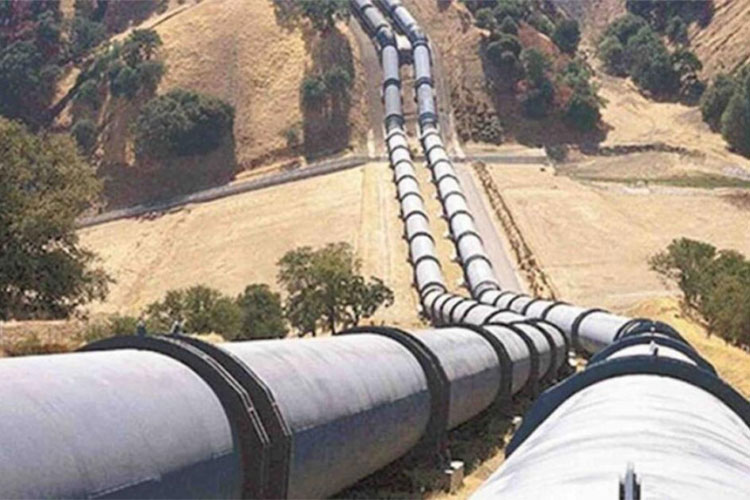
Among the issues that the Moroccan authorities tried to cover up were the losses suffered by the Moroccan economy after the Algerian authorities decided not to renew the contract for the flow of gas to Spain through the Moroccan pipeline, which crossed Moroccan territory, on October 31, 2021, following the Algerian party’s decision to break off diplomatic relations, among other things. This led to harsh penalties that affected Moroccan interests.
It is known that Morocco was receiving, under the agreement to pass the pipeline through Moroccan territory before it reached Spain, significant quantities of gas in its natural form, along with financial liquidity in dollars, stipulated in the contract, which is the fees for passing the pipeline, but all these privileges were stopped immediately from November 1, 2021.
Also, two of the power plants, the “Tahadarat” and “Beni Mazhar” power plants, were operating with gas coming from Algeria through the stopped pipeline, which was the reason for their complete cessation of activity. For how long have they been out of service? What solutions did the Moroccan government resort to in order to resume their operations, which were concealed at the time, at a time when the Moroccan party declared that it had taken all measures in anticipation of Algeria’s sovereign decision to stop work on the pipeline?
In this context, an on-the-spot investigation dealt with some of the aspects that the Moroccan economy suffered as a result of the Algerian party’s decision to cut off the gas. According to the “Taqa” platform, which visited the “Tahadart” station near the city of Tangier, which is about 260 kilometers from the Moroccan capital, Rabat, this station stopped generating electricity for about eight months due to the lack of gas, noting that it provides electricity to areas in the south of the country in the Kingdom of Morocco.
The “Tahadarat” station, inaugurated in 2005, with investments estimated at around 311 million dollars and a production capacity of almost 400 megawatts, is an institution whose shares are majority controlled by two foreign companies, namely the Spanish company “Endesa” with 32 percent and the German company “Siemens Energy” with 20 percent, while the remaining percentage, estimated at 48 percent, is controlled by the Moroccan government.
According to the same source, the Moroccan government was torn between permanently suspending its activity or temporarily closing it for a year until its gas needs were met. In the end, it was not restarted until July 2022, more than eight months after it was shut down, the source quoted Moroccan officials as saying.
The station did not return to operation until the Moroccan government signed a 12-year contract with the international company Shell to import about 500 million cubic meters of liquefied gas per year to ensure the continuity of the operation of the “Tahadarat” and “Beni Mathar” stations, which the Moroccan government is buying. The liquefied gas will then be converted into natural gas in Spanish vehicles before being transported in the opposite direction through the Maghreb-Europe gas pipeline from Spain.
The decision to export gas from Spain to Morocco had provoked a strong Algerian reaction because of the suspicion that Madrid might export Algerian gas to Spain via the “Medgaz” pipeline, which links Algerian and Spanish territory directly, without passing through Moroccan territory. On that day, however, the Spanish party gave its Algerian counterpart guarantees that not a single “drop” would be exported, which allowed the process to proceed without obstacles.
This study reveals only part of the impact on the Moroccan economy of stopping the flow of Algerian gas, which affected only two power plants. What about the other sectors of activity, especially since the interruption came at the height of winter and spring, when the demand for gas is usually high? At its peak, the amount of gas covered by the contract with the international company “Shell” was directed only to the two stations that were no longer in operation.